New Spanish serie of coins in 2010
Posted: Thu Jul 16, 2009 12:37 am
http://www.pulifil.es/" onclick="window.open(this.href);return false;
Click here if you want to track your Euro banknotes
https://forum.eurobilltracker.com/
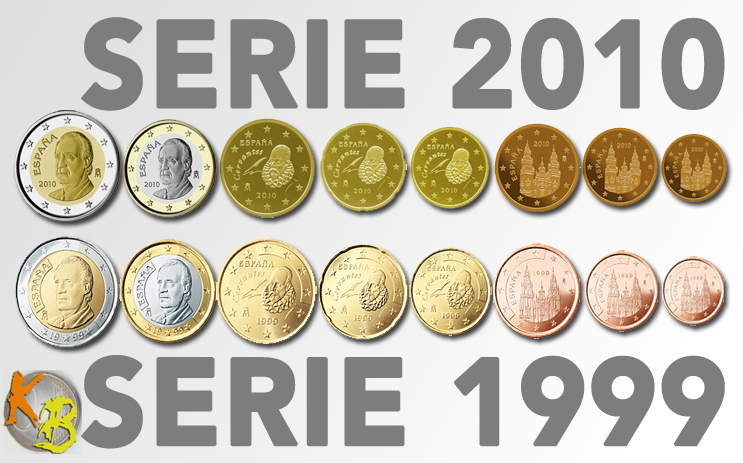
 For the 'yellow' coins, the variation is so light that I don't mind at all.
This is because Spanish had a strict interpretation of the 4th article in the 2009-12-19 EU Commission recommendation (on common guidelines for the national sides and the issuance of euro coins intended for circulation):androl wrote: hmm, the only thing they do is put away these panels with inverse stars and writing
this will make the 1€ and 2€ coins look somehow different, I even think better, but at the cent coins you don't really realize the change
... now I see they also move the "M" and the year to different positions, but only on the 1€ and 2€
This means that not only German, Greek and Austrian coins, who doesn't report any indication of their issuing country, has to change like already done by Finnish and Belgian coins, but even Luxembourgish, Slovenian and Dutch should change, and even Monaco. And what about French design? The stars doesn't "fully" surround the national side neither there (and in the 1 and 2 € coins the year is written in the circle)..."The national side of the euro coins intended for circulation should bear the 12 European stars that should fully surround the national design, including the year mark and the indication of the issuing Member State's name. The European stars should be depicted as on the European flag."
Extremely strict indeed. After all, the Commission recommendation (December 2008) and the Council conclusion (February 2009) specifically say that "No changes are required to the national sides and edge letterings of both regular and commemorative euro coins intended for circulation which have been first issued or approved according to the agreed information procedure prior to the adoption of these conclusions."Al s'é pers wrote:This is because Spanish had a strict interpretation of the 4th article in the 2009-12-19 EU Commission recommendation (on common guidelines for the national sides and the issuance of euro coins intended for circulation)
 And fortunately so, I think - this new rule makes the area that can be used for the actual design very small ... .
this has been done on all national designs, but there are some few German coins where the stars have turning orientation, where one tip is pointing out of the circle and two are pointing to the inner part. This has been a fault of the designer and was found out when the first minted coins were showed to the public in 1998, then all the coins had to be melted and new coins had to be madeCraft wrote:"The European stars should be depicted as on the European flag" actually imply that the stars should be not only in a circular constellation but also in the same orientation (standing on two of their tips, one tip pointing up),

That's funny, and I didn't know about that incident beforeandrol wrote:there are some few German coins where the stars have turning orientation, where one tip is pointing out of the circle and two are pointing to the inner part. This has been a fault of the designer and was found out when the first minted coins were showed to the public in 1998, then all the coins had to be melted and new coins had to be made
That wikipage shows both the correct and an incorrect version of the EU flag. When I look at them as a whole (squeezing my eyes a little), the incorrect one actually seems graphically more pleasing to the eye than the correct oneandrol wrote:http://de.wikipedia.org/wiki/Drehende_Sterne
, since the ring of stars is perfectly balanced when one tip is always pointing directly out from the centre.That is because the Stuttgart (F) variety is the least expensive one among those pieces.androl wrote:http://cgi.ebay.de/ws/eBayISAPI.dll?Vie ... 0457233519 someone paid 1135 euros for such a coin
 Hamburg (J) is about twice that price ...